Tuesday, October 11, 2022

Discipleship: Foundations, Definitions, and Selected Resources

Dan and Debbie have recently become followers of Jesus. Almost everything about church is new to them. They say, “We have so much to learn. There are so many ways that we want to be involved in the life of this place. We love it here.”

Let us think together about Scripture and other resources that we should consider as a foundation for discipling them and assisting with their spiritual formation? What will be the next steps for them?

This blog includes the discipling-related topics of Scripture, definitions, and foundational resources with special attention to the book The Master Plan of Evangelism.

There are many Scripture passages that speak specifically to discipleship. Several of these follow.

“Therefore go and make disciples of all nations, baptizing them in the name of the Father and of the Son and of the Holy Spirit, and teaching them to obey everything I have commanded you”… Matthew 28:19-20).


”Follow me and I will send you out to fish for people” (Mathew 7:19).

“Whoever serves me must follow me” (John 12:26)

“Follow my example, as I follow the example of Christ” (1 Corinthians 11:1).

Two descriptions or definitions of discipleship are helpful to me. The first describes disciples as
a. beginning with a profession of faith in Jesus Christ,
b. developing by involvement in a process of spiritual formation and
c. finding expression in acts of Christian service ( www.maninthemirror.org. Morley).

The second defines discipleship as the nurturing of Christ-followers who are growing as learners; practice biblical behaviors or habits that enable them to live the Christian life effectively; display behaviors or habits such as prayer, sharing faith, Bible study, and serving; and multiply Christ-likeness in the lives of others (Stetzer, Planting Missional Churches. p. 281).

Following are some of the foundational resources in discipleship literature and a brief quote from each book. I will give extra attention to the last featured book, The Master Plan for Evangelism.

Bruce, A.B. Training of the Twelve (1871).
“Jesus gave His disciples lessons on the nature of the divine kingdom, on prayer, on religious liberty, on the nature of true holiness, on humility… on self-sacrifice… on the mission of the comforter, to convince the world and to enlighten themselves.”

Bonhoeffer, Dietrich. The Cost of Discipleship (1949).
A contrast is made between cheap grace and costly grace. "Cheap grace is the grace we bestow on ourselves...grace without discipleship....Costly grace is the gospel which must be sought again and again....It is costly because it costs a man his life, and it is grace because it gives a man the only true life."

Ogden, Greg. Discipleship Essentials. (1998).
The book is divided into four parts: Growing Up in Christ, Understanding the Message of Christ, Becoming Like Christ, Serving Christ. Each chapter contains a core truth, memory verse, inductive Bible study, and additional readings. An appendix describes how to build a discipleship ministry.

Coleman, Robert E. The Master Plan of Evangelism (1963).
“…a study in principles underlying His ministry-principles which determined His (Jesus) methods.” Chapter headings: Selection, Association, Consecration, Impartation, Demonstration, Delegation, Supervision, and Reproduction.

Selection: Jesus chose a few faithful, available, teachable disciples. (Luke 6:13-17, Mk 3:13-19). They weren't scholars, or individuals with special talents, just ordinary people whom he could shape and mold into leaders.

Association: He devoted his time to them, even in the midst of ministry to the masses. They were with him in all sorts of situations -called to simply "be with him" and "follow him."

Consecration: Jesus called these disciples to obedience- to turn away from sin and sacrifice their own personal interests- to turn to him and his teaching. He called them to commit themselves not to a doctrine or program, but to his person.

Impartation: He gave himself to them and for them. The foundation of their relationship to him was his love and self-denial. His commitment to them and giving of himself for them was the motivation of their giving themselves totally for him.

Demonstration: Jesus taught them by showing them. All the disciples had to teach them was a teacher who practiced in front of them what he expected them to learn. So they learned to pray by hearing him pray, learned how to use the Word by observing his handling of it, learned how to minister by watching him ministering.

Delegation: He put them to work (Mk 6:7, Mt 10:5, Luke 9:1,2). They assisted Him as He ministered, gradually he sent them out two by two. The instructions he gave them are most interesting, revealing how even this was a part of their preparation as his disciples.

Supervision: Jesus kept check on them and used their experiences to instruct them further (Mk 6:30). This was “on-the-job training” at its best. They were given adequate room to work and learn, yet never without his concern and guidance as it was needed.

Reproduction: It is clear that he intended them to become disciplers. The church is like the mustard seed; it starts out small- yet we expect it to grow bigger than the crops around it (Jn 15:1-17), for the branch abiding in the vine must bear fruit.


In summary, this has been an overview of Biblical foundations, definitions, and selected resources for discipleship. It has focused on the command of Jesus to make disciples and has provided a few classic resources. For those interested in further readings on discipleship, consider the following resources.

Bonhoeffer, Dietrich. The Cost of Discipleship (1949).
Bruce, A.B. Training of the Twelve (1871).
Coleman, Robert E. The Master Plan of Evangelism (1963).
Ogden, Greg. Discipleship Essentials. (1998).
Stetzer, Ed. Planting Missional Churches. (2006).

The books listed here are personal favorites of this writer. Placing them here is like providing the names of good friends, individuals who have influenced my life and ministry. A small commission may be provided to me for books purchased. Church and School Education (CASE) Resources is a participant in the Amazon Services LLC Associates Program, an affiliate advertising program designed to provide a means for sites to earn advertising fees by advertising and linking to Amazon.com.

Line drawings are from the following web site https://www.rotation.org/topic/public-archive-of-annie-vallotton-bible-images-400px-wide-archive and appear in the Good News Bible.
  

This blog is also available as a YouTube video by clicking here.

Wednesday, September 28, 2022

Curriculum Basics

If you don't know where you are going, any road with get you there. - Lewis Carroll

This blog identifies several basic curriculum terms and processes to help educators know the path or road to construct in their planning. These terms include
-- Defining the word “curriculum,” 
-- Identifying four key curriculum questions,
-- Describing what is meant by “scope and sequence,” and
-- Defining the term “spiral curriculum.” 


Curriculum is defined as a course or path of study. The curriculum of an organization answers the questions: what, why, to whom, and how to accomplish the learning goals of an organization or group. These four questions help us move along the teaching-learning pathway.
1. What should we teach?
2. Why should we teach this topic or topics?
3. Who will we be teaching?
4. How are we going teach?

 What should we teach? This a question about the content or subject matter to be taught.

“What” is interrelated with “why.” These two questions should be dealt with simultaneously. If they are not, we may find ourselves teaching content without reason or having reason without content for accomplishing our purposes.

Why teach this topic or topics? “Why” is a question for identifying objectives, or goals (intentions). Why addresses the rationale for teaching a topic.

Goals are generally understood to be general purpose statements that apply to a thematically grouped number of lessons or units. Objectives are typically defined as behaviors that can be identified as a result of a specific lesson.

Who will we be teaching? This question asks us to identify a specific group of learners. Are they children, youth, adults, or a multi-generational group? What are their cultural characteristics?  Do they have an advanced or beginning knowledge of the subject matter?

How are we going to teach? The “how” question asks about the methods, procedures, environment, and conditions by which we plan to teach. Will teaching-learning methods be directive or participatory? Will we be giving a lecture (information giving), leading a discussion (discovery learning), telling a story (imagination), or something else? Where will this teaching take place?

Curriculum planning also deals with “scope and sequence.” Scope and sequence refer to the “what” and “how” of teaching. They are part of the curriculum planning process.

Scope refers to topics that are to be taught; specifically, how basic or difficult will the content be from beginning to the mastery levels? Sequence is the order in which topics are to be taught over time.

Another component of is referred to as the “spiral curriculum.” The term “spiral curriculum” refers to concepts being repeated throughout the curriculum, repeated with increasing depth and complexity according to the prior knowledge and development level of the learners.

This presentation has been an introduction to several basic curriculum topics. These include defining curriculum, four curriculum questions, scope and sequence, and spiral curriculum.

These areas are key to planning teaching and learning experiences in any educational organization.

Following are references on which this material is based.

Bruner, Jerome. The Process of Education. Harvard, 1960 and The Spiral Curriculum

Tyler, Ralph W. Basic Principles of Curriculum and Instruction. University of Chicago Press, 1949

Ward, Ted. Curriculum: The Path to High-Worth Outcomes. Common Ground Journal. v10 n1 (Fall 2012) 43

This blog is also available as a YouTube video, click here.


Friday, September 16, 2022

The Seven Laws of Teaching

How would you begin your book about teaching if you were one of the most famous educators of your time…

If you were President of two major universities;
If you were State Superintendent of Education;
If you were founder of a major journal on education;

If you were Dr. John Milton Gregory (1822-1898)?

This author began with a quote from the Bible: Proverbs 22:6
Train up a child in the way he should go: and when he is old he will not depart from it. 

That is how the educational classic, The Seven Laws of Teaching (1886), begins.

John Milton Gregory was founder of the Michigan Journal of Education, Superintendent of Public Instruction for the State of Michigan, President of Kalamazoo College, and President of the University of Illinois.

What follows are Gregory’s “Seven Laws,” or rules, for teaching. Each one also has a brief explanation. The “Laws” are:
1. The Law of the Teacher
2. The Law of the Learner
3. The Law of the Language
4. The Law of the Lesson
5. The Law of the Teaching Process
6. The Law of the Learning Process
7. The Law of Application and Review

Here they are in greater detail.

The Law of the Teacher
“A teacher must be one who KNOWS the lesson or truth to be taught.”
Teachers are to have a firm and thorough grasp of the material that they plan to teach.


 The Law of the Learner
“A learner is one who ATTENDS with interest to the lesson given.”
There is no learning without attentiveness and interest.


The Law of the Language
“The language used is a MEDIUM between the teacher and learner and must be COMMON to both.”
The words used by teachers are to be understood by both teacher and learner in the same sense. The language must be clear and vivid to both alike.


The Law of the Lesson
“The lesson to be learned must be explained in the terms of what is already known by the learner — the UNKNOWN is to be explained by the KNOWN.“
Begin with what is already well-known or mastered about a topic, subject, concept, or skill. Then proceed to the unknown by single, easy, and natural steps, letting the known explain the unknown.


The Law of the Teaching Process
“Teaching is AROUSING and using the learner’s mind to form in it a desired thought, attitude, or skill.”
Use the learner’s own mind, exciting their self-activities. Keep their thoughts, as much as possible, ahead of your direct input, helping them discover that which is to be learned.


The Law of the Learning Process
“Learning is THINKING and BEHAVING into one's own UNDERSTANDING and ABILITIES a new idea or skill.”
This requires learners to reproduce in thought or action the lesson being learned—thinking it out in its parts, proofs, connections, and applications until they can express it in their own language or behaviors.


The Law of Application and Review
“The test and proof of teaching done is a finishing and fastening process that requires RE-VIEWING, RE-THINKING, RE-KNOWING, and RE-PRODUCING of the material taught.”
Review in order to reproduce correctly the old, deepening its impression with new thoughts, correcting false views or behaviors, and completing correctly what was taught and learned.


Summary and conclusion
You have been introduced to the “Seven Laws.” These “Laws” give us a way of thinking about education. They help us look at teaching and learning from seven different, but interrelated, perspectives – i.e., teacher, learner, language, lesson, teaching process, learning process, and review and application.

Each of the laws is developed in detail in Gregory’s book. You can find a free downloadable copy by clicking on “Free ebooks…” in our Virtual Resource Center. The book is also available in print by clicking “Recommended books to purchase,” also in the above Virtual Resource Center. This blog can also be viewed on our YouTube channel by clicking here

Wednesday, September 7, 2022

The Bible: A Beginning Introduction

This blog contains a summary of the message of the Bible, description of how the Bible is organized, and suggestions for Bible reading.

If someone who had never seen or read a Bible asked you, “What’s that book about?,” what would you say?

The Bible is about redemption (deliverance) through Jesus Christ. One early Christian leader described four states of Redemptive history (Augustine, 354-430 AD).

·       Creation: able to sin, able not to sin (posse peccare, posse non peccare)

·       Fall: not able not to sin (non posse non peccare)

·       Redemption: able not to sin (posse non peccare) – again

·       Consummation: not able to sin (non posse peccare) 

Another way to identify the purpose of the Bible is to see what the Bible says about itself. Note the following verses.

·       “I have hidden your word in my heart that I might not sin against you” (Psalm 119:11).

·       “When you received the word of God… you accepted it not as the word of men, but as it actually is, the word of God, which is at work in you who believe” (1 Thess. 2:13).

·       “All Scripture is God-breathed and is useful for teaching, rebuking, correcting and training in righteousness so that the man (person) of God may be thoroughly equipped for every good work” (2 Timothy 3:16, 17).

·       “For the word of God is living and active. Sharper than any double-edged sword, it penetrates even to dividing the soul and spirit, joints and marrow; it judges the thoughts and attitudes of the heart” (Hebrews 4:12). 

The Bible is a library of different types of literature, rather than a single book (Greek biblia—books [plural]).

        66 Books total

        Old Testament: 39 books

        New Testament: 27 books


Old Testament Structure


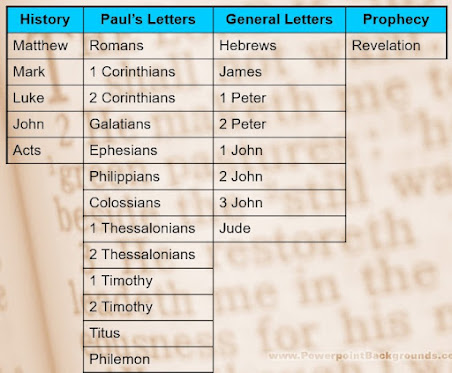
New Testament Structure


The Bible is meant to be read and if you are interested, you may want to begin by reading selected passages or having a daily reading or listening plan or even starting with any place that looks interesting.

1. Selected passages to consider could be the following five Bible books.

        Genesis: early history

        Psalms: poetry

        Mark: life and ministry of Jesus

        Acts: early church

        1 Peter: letter to churches 

2. A daily reading or listening plan is helpful for many. The following link is an example of one plan. You can read the Bible in a year with a printed plan like this.


My wife and I listen to the Bible each morning with the Daily Audio Bible.

3. You could also begin with any topic that is of personal interest. Think of a topic and Google it with the word “Bible” in the search line (e.g., faith, hope, joy, temptation, encouragement).

This blog has contained beginning thoughts about introducing the Bible. The purpose of the Bible is to tell the story of redemption through Jesus Christ. This is called “redemptive history.” The Bible is a book containing 66 books that are divided into the Old and New Testaments. You are encouraged to read the Bible for yourself and decide how its message applies to you.

To learn more, you will find free e-books, videos, and articles as well as recommendations for purchasing books and other products in the Virtual Resource Center at the top of this site.

If looking for a Study Bibleclick here.

Church and School Education (CASE) Resources is a participant in the Amazon Services LLC Associates Program, an affiliate advertising program designed to provide a means for sites to earn advertising fees by advertising and linking to Amazon.com.

To view this presentation on my Youtube channel, click here.

For a free e-book, The Beginner's Guide to the Bible, click here.


Monday, September 5, 2022

Prayer at the Beginning of a New School Year

God of new beginnings, we pray for the start of a new school year.

We pray for our teachers. We thank you for the heart that each of them has to invest in the lives of young people and pray that they are encouraged in their work. At a time when so many teachers are burning out, we pray for renewed strength and energy. May the teachers of our community know how deeply you love them and desire for them to experience the fullness of life in you.

We pray for our school administrators. We pray for wisdom for the decisions that they must make to guide the schools of our community. We pray for healthy relationships between faculty and administration.
We pray for school staff members, paid and volunteer. We pray for the important logistical work they do to ensure good education. We thank you for their selfless service and ask you give them strength and perspective in the work they do..
May the administrators and staff of our schools know how deeply you love them and desire for them to experience the fullness of life in you.
We pray for students. We pray for the students who are starting school for the first time and for those at new schools. Calm their nerves, and soothe their fears. For students who feel left out and alone, we pray for a welcome embrace. We pray for the many pressures our students will face - pressure to conform and pressure to perform.
May the students of our community know how deeply you love them and desire for them to experience the fullness of life in you.
We thank you for the gift of knowledge and the opportunity to better understand your world and who we are within it. We join our prayers with those around our communities and pray a canopy of support, protection, and love over the teachers, students, and schools in our community.
We pray all these things in the powerful name of Jesus, Amen.
This prayer is a slightly modified version of that used by Pastor Nate Schipper on Sunday, August 28,2022 at Fellowship Church, Holland, Michigan. He edited it from a group called Movement West Michigan.

Wednesday, August 31, 2022

Lesson Planning for Church Education


     Are you looking for a good way to get ready to teach your class?

         Do you want to find a process that works for you?

There are many valuable approaches for preparing to teach. In this post, I describe one of the most effective processes for lesson preparation. The approach suggested here has stood the test of time.

It was developed by Dr. Lawrence O. Richards (1931-2016), a teacher and author of more than 200 books on education, leadership, and Bible studies. Richards called it the Hook, Book, Look, Took method in his text, Creative Bible Teaching (1970).

Here are the four steps of lesson preparation.

·        Get the attention of class members (Hook).

·        Identify what you want to teach and the activities for doing it (Book).

·        Apply the lesson to life (Look and Took).

Following is a description of each step and a sample lesson planning worksheet.

A good “Hook” is a question or statement or activity that snags the attention of group members. It is one of the first things to do during class time. Hooking involves:

·        Connecting with the life interests of learners.

·        Cultivating curiosity.

The “Book” step refers to the content and process of class time. This is where a Bible passage is read and discussed, Bible stories are told, videos are watched, presentations are made, or learners are involved in other learning experiences. “Book” takes the majority of class time and includes:

·        Information and activities related to the lesson topic,

·        Initial hints about the relationship between the information and the lives of the learners.

“Look” begins lesson application. During the look step the teacher is interested in:

·        Ideas in the lesson that seem most relevant for meeting the needs of learners,

·        Involvement by participants to define for themselves ways of applying the lesson.

“Took” asks, What should learners take away from class? How does the lesson impact the attitudes, behaviors, and commitments of group members? This step addresses:

·        Attitudes: In what ways might learners be encouraged to think and feel differently?

·        Behaviors: What could participants be asked to do as a result of the lesson?

·        Commitments: What life decisions could learners consider making?


LESSON PLAN WORKSHEET

Date______________

Lesson Title/Theme___________________


Hook: words and activities to engage learners.

____________________________________________________________


Book: content and activities for information, attitudes, and/or skills to be presented and experienced.

Content_____________________________________________________

Activities____________________________________________________


Look: Ideas most relevant to the learners.

___________________________________________________________


Took: Attitudes, behaviors, and commitments to take-away.

___________________________________________________________


Name of person leading the lesson:_________________


Post meeting notes:__________________________________________

This has been an overview of lesson planning. It is based on the book Creative Bible Teaching. You are invited to further pursue this approach. The original text by Lawrence O. Richards is out of print and has been replaced with an even-more-comprehensive revised edition that includes the same four steps.

For purchase information about the book, click here.

To watch a YouTube video related to this topic, click here


Friday, June 10, 2022

Michelangelo Sistine Chapel Exhibit

 Went to the Michelangelo Sistine Chapel Exhibit at the Gerald R. Ford Presidential Museum (Grand Rapids, MI). I am not sure about the rationale for the Sistine Chapel being featured at a Presidential Museum but am grateful for the experience.

Marlene and I have been to the Chapel in Rome twice. This exhibit wonderfully complemented our
visits. The Chapel itself is so awesome, so spectacular that it overwhelms the senses. Here we were able to examine specific scenes close-up. Some of these are pictured: creation, ceiling frescoes, and last judgement.
Do not miss this exhibit if you live in West Michigan (here until September 11) and if not, watch for it in your area.


Sunday, May 22, 2022

Viking Rhine River Cruise - Amsterdam to Oberammergau, May 7-18, 2022

Day 1: Amsterdam, The Netherlands. On board a Viking longboat in Amsterdam, preparing to get underway on the Rhine. Marlene and I have been looking forward to this trip for over three years. We were originally scheduled for 2020 but, because of Covid-19, it was postponed for two years. Being here feels like a dream. Pictures and stories follow.


Day 2: Kinderdijk, The Netherlands. These are the famous windmills of Kinderdijk. Nineteen of them are clustered together for water management. And, even though we are onboard a longboat, the ship’s Wi-Fi allowed us to worship with our home church, Fellowship Reformed, Holland Mi and attend Petra’s (our granddaughter) graduation from Hope College. God is good.


Day 3: Cologne, Germany. This is the famous Gothic Cathedral of Cologne, Germany. We toured the old city of Cologne but spent most time at the Cathedral. Its beginnings date back to 1248 and it is the largest in Norther Europe. A magnificent gold altar inside the Cathedral is said to contain the bones of the Magi. Go figure. Who would expect to find the three kings in Cologne. I wonder if it had anything to do with the fragrances.


Day 4. Viking River Cruise. The highlight of the day was castle viewing on the the “Middle Rhine.” The River is lined with more than 28 castles, often dating back to the 1200 and 1300’s. We were able see many of these ancient domains. Our Program Director narrated as we navigated through this stage of our journey. As intriguing as they are, castles often have stories of conflict and conquest, as do a number of other things that we build in this life. I am reminded of the old gospel hymn…
I've got a mansion just over the hilltop
In that bright land where we'll never grow old.
And some day yonder, we will never more wander.
But walk on streets that are purest gold.


Day 5: Heidelberg, Germany. Meet Fredrick the Third (also called Fredrick the Pious, 1515-1576). We found this statue of him the wall of the Heidelberg Castle (Heidelberg, Germany). He is to be thanked for commissioning, implementing, and defending the Heidelberg Catechism. Do you remember Question and Answer 1 of the Catechism?
Q. What is your only comfort in life and in death?
A. That I am not my own, but belong—body and soul, in life and in death - to my faithful Savior, Jesus Christ.
He has fully paid for all my sins with his precious blood, and has set me free from the tyranny of the devil. He also watches over me in such a way that not a hair can fall from my head without the will of my Father in heaven; in fact, all things must work together for my salvation.
Because I belong to him, Christ, by his Holy Spirit, assures me of eternal life and makes me wholeheartedly willing and ready from now on to live for him.


Day 6: Strasbourg, France. This is a spectacular city. I could tell you stories about conflicts between France and Germany, the European Union Parliament building, or the famous Cathedrale Norte Dame de Strasbourg and its astronomical clock. The below picture is of the inside of Cathedrale Norte Dame.

Day 7: Breisach, Germany, The Black Forest. There were several Black Forest-related choices for today. We choose the cuckoo clock demonstration, a walk down a path in the Black Forest, and - my favorite - how to make a decadent Black Forest Cake. What could be better than whipped cream, chocolate sponge cake rounds, cherries, shaved chocolate, and schnapps!


Day 8: Innsbruck, Austria
Innsbruck is a city with astounding sculptures, historic buildings, beautiful churches, and scenic views. We toured Old Innsbruck, viewed the 3:00 PM worship service (9:00 AM Michigan time) of Fellowship Church, and are going to an “Austrian Folklore Evening” dinner, folklore, and music. This is an amazing city!
Can you see the Love in the pictured sculptured? It is not as easy to see the Hate but somehow the artist was able to build it into the reverse side of this piece. It should also be easier for others to see the love in our lives, and may God forgive and cleanse any hate… “Wash me and I shall be whiter than snow,” (Psalm 51:7).


Day 9: Bavaria, Germany.
Our senses are assaulted by the buildings and breads of the Bavarians. Today we had a few hours to explore the quaint town of Mittenwald (famous for crafting violins). It has a storybook look.
We lunched at a bakery/coffee shop. I can still taste the light and lemony pastry… out of this world. Also, the buildings in this town are a delight to the eyes, covered with colorful paintings.
We, next, visited an historic Benedictine monastery, Etta Abby. From there it was a motor coach ride to our hotel in Oberammergau where we will experience the Passion Play tomorrow.


Day 10: Oberammergau, Germany, The Passion Play.
The Passion Play is the culmination of our cruise. This event pictures the biblical story of salvation with an emphasis on the triumphal entry, crucifixion, and resurrection of Christ. The town of Oberammergau (population of about 5,500) has been putting on "Passionsspiele" every 10 years since 1633 in gratitude to God for being spared from the Black Plague.
There are 106 performances between May and October. One thousand residents make up the performers and support staff. The open air auditorium seats 5,000.
The Play is an 8 hour experience, in German: part 1 (2.5 hours), dinner break (3 hours), part 2 (2.5 hours). After being delayed for 2 years because of the Covid 19 pandemic, we were blessed to be present at this epic event.
The Play ended at 10:30 PM. We left for the airport at about 5:00 AM the next day and landed in Grand Rapids at around 5:00 PM. Thank you Lord!