Friday, February 16, 2024

Benjamin Bloom and Planning Cognitive Objectives

One of the first steps in planning to teach is thinking about the desired outcome(s) of a learning experience. Whether shaping behaviors, attitudes, experiences, or knowledge; defining clear goals or objectives is basic to the process. Defining objectives answers the question, “What are the intended results of a teaching-learning experience?” This article describes a valuable resource specifically developed for planning knowledge outcomes.

Delving into the cognitive domain, we explore the work of Benjamin Bloom in understanding and planning cognitive outcomes. Benjamin Bloom is one of the legends in the landscape of learning luminaries. An educator at the University of Chicago in the 1950s, he is best known for what is popularly referred to as “Bloom’s Taxonomy.” The name comes from the title of his 1956 publication, "Taxonomy of Educational Objectives: The Classification of Educational Goals" (co-authored with Max D. Engelhart, Edward J. Furst, Walter H. Hill, and David R. Krathwohl, with minor modifications made in 2001).

The Taxonomy is a hierarchically structured classification system of learning goals in the cognitive domain. The Taxonomy continues to be a foundational reference for helping teachers and curriculum developers plan, implement, and evaluate learning at different levels of thinking. This article will define key words, describe the different levels of the Taxonomy, identify common terms for writing cognitive objectives, provide an example for each level, and suggest questions that can be asked by teachers for each of the levels. Finally, applicational assumptions and advice are given for applying Bloom’s work to church and school education.

Key Words for Getting Started

Three key words are worth noting. These are taxonomy, hierarchy, and cognition.
Taxonomy is a term used in the sciences to name and organize things into groups that have similar characteristics.
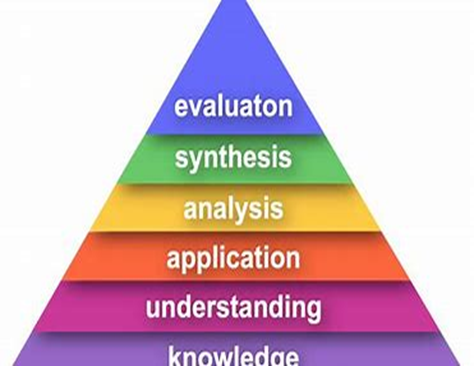
Hierarchy, as used in Bloom’s taxonomy, refers to levels of thinking being built upon one another, with mastery of one level normally necessary before being able to fully function at the next level. To visualize this, the structure of a pyramid is used in Bloom’s design.
Cognition refers to intellectual and mental processes that are used in acquiring knowledge of facts as well as reasoning, reflection, and critical thinking skills.

Levels of the Taxonomy and Related Resources
The following descriptions summarize the six levels of the taxonomy. In the original work, The levels are knowledge, comprehension, application, analysis, synthesis, and evaluation (see End Note for the updated list of these terms). Each level is defined and supplemented with an example of an outcome statement, outcome-related words, and questions representative of that level. These can be used by teachers in planning cognitive results.


Knowledge defined: Recalling specific factual information. This level is the foundation for future levels

Outcome example: Name three moral values.
Outcome words: Define, list, recognize, state, tell, what, who, and write
Questions: What is …? Where is …? How did ___________ happen? How would you describe …? Can you recall …? Can you list three …?


Comprehension defined: Understanding the meaning of information.
Outcome example: Summarize what it means to forgive someone.
Outcome words: Compare, discuss, explain, locate, paraphrase, show, summarize, and tell.
Questions: How would you compare …? Contrast? How would you rephrase the meaning …? What is the main idea of …? How would you summarize …? What can you say about …? Can you explain what is happening …? What is meant by…?

Application defined: Using knowledge in a new but similar form about a particular situation.
Outcome example: Talk about words and behaviors that show an understanding of forgiveness in a real-life situation.
Outcome words: Choose, develop, demonstrate, use, model, illustrate, predict, solve, plan, select, and organize.
Questions: How would you use …? How would you show your understanding of …? What approach would you use to …? What would result if …? What facts would you select to show …? What questions would you ask in an interview with …?

Analysis defined: Taking knowledge apart and breaking it into its primary segments.
Outcome example: Compare and contrast the different ways of dealing with forgiveness.
Outcome words: Categorize, classify, compare, diagram, distinguish, examine, outline, separate, simplify, and survey.
Questions: What are the parts or features of …? Why do you think…? Can you list the parts …? What is the relationship between …? What is the function of …? How would you categorize …?

Synthesis defined: Putting together the parts of information to create something new.
Outcome example: Summarize what you would like a person to say to you in asking forgiveness regarding an issue that has created tension between you.
Outcome words: Arrange, compile, compose, construct, create, design, formulate, modify, summarize, and theorize.
Questions: How would you improve …? What would happen if …? What way would you design …?
What would you adapt _______ to create a different …? Can you predict the outcome if …? Can you think of an original way for …?

Evaluation defined: Making judgments about the value of information and ideas.
Outcome example: Describe your opinion about a person who refuses to forgive and tell why you feel this way.
Outcome words: Appraise, award, conclude, contrast, criticize, measure, judge, justify, evaluate, value, estimate, and give an opinion.
Questions: Do you agree with …? What is your opinion of …? What would you recommend …? How would you evaluate …? How would you compare …? Why was it better that …?

Applicational Assumptions for Church and School Education
Several qualifiers should be noted for the use of the Taxonomy. These include the following.
--Learners may function within more than one of the domain levels during an educational activity.
--Cognition is a dynamic process requiring flexibility in a learning experience.
--Some levels of the Taxonomy may be more relevant than others in a specific teaching-learning situation. It is not necessary to move consecutively through all the levels in every situation. Learners bring their prior knowledge and learning styles.
--Humans, as image bears of God, reflect a divine complexity that frequently does not comply with even the best lesson plans and curriculum designs.
--The Taxonomy is a resource and not a formula or prescription. When planning, teachers should give priority to the needs of students and the learning environment.

Applicational Advice for Church and School Education
--Normal learning, in most cases, progresses from simple to complex. The natural progression of thought development requires competence in lower levels of the taxonomy as a basis for more complex mental structures. Start simple, activate prior knowledge, and teach in ways that meet needs, including those that are moral, ethical, spiritual, social, psychological, and relational.
--Instructional design involves planning learning activities that are based on assessments made by teachers. These assessments may be made by using formal or informal tools, but the interpretation of these tools is a teacher’s responsibility. Teachers, (not books or media) have the privilege of cultivating higher-level thinking skills.
--To the degree that they are able, it is the role of teachers to challenge students to higher, deeper, and more complex levels of thinking, to awaken thought processes in learners that reflect their God-given dignity, worth, and capacity for productive, righteous, loving, joyful, peaceable, and hopeful living.

Summary
This presentation has provided an overview of Bloom’s Taxonomy and its application to church and school education. Definitions and key words were given to understand the Taxonomy and examples were provided for planning educational outcomes. Assumptions and advice were also provided regarding the limitations, as well as the potential benefits of goals and objectives for educational planning. Teachers have the privilege of challenging learners to develop their minds and thought processes to achieve greater depth and complexity through the use of the Taxonomy as a planning tool.

Resources
Bloom, Benjamin. Taxonomy of Educational Objectives: The Classification of Educational Goals.
https://ia803005.us.archive.org/15/items/bloometaltaxonomyofeducationalobjectives/Bloom%20et%20al%20-Taxonomy%20of%20Educational%20Objectives.pdf

Bilon, Edmund. Using Bloom’s Taxonomy to Write Effective Learning Objectives.
https://amzn.to/42oAIR5

SimplyPsychology web site page. Bloom’s Taxonomy of Learning | Domain Levels Explained (simplypsychology.org)

YouTube video of this blog. https://youtu.be/X6wmHvV-99Y

Supplementary online resources that may have been consulted include ChatGPT, Google Search, Google Bard, Bing, and Wikipedia

Church and School Education (CASE) Resources is a participant in the Amazon Services LLC Associates Program, affiliate advertising designed to provide a means for sites to earn fees by linking to Amazon.com.

Tuesday, January 30, 2024

How to Write a Project Proposal

Proposals come in all kinds of sizes and shapes. This presentation is built on what I have learned about proposal writing as an administrator, from working with both the well-thought-out and tightly organized to the unrealistic or incomplete. As a result of the information that follows, you should be able to develop a convincing program proposal for your business, church, or school.

Clark is a floor supervisor at a company that manufactures fabric materials for the automobile industry. It is called “Eagle Wings Group,” or EWG for short. Crew members are highly competent at running industrial-level, heavy-duty sewing machines. Many are immigrants from Asian countries. They are hard-working employees but are new to West Michigan culture and often in need of support for navigating through basic life and employment responsibilities.

Clark’s company is led by individuals with a strong work ethic and commitment to moral and religious values. They care about their workers, even to the extent that the company’s mission statement includes the desire to “make a difference in one another’s lives.”

Clark has come up with the idea of starting a “coaching” program for his crew, and maybe even throughout the company. Clark, himself, has had coaches and mentors and would love to see others benefiting as he has.

However, Clark has never developed a proposal and is wondering what to include before bringing the idea of coaching to his boss. So, he shares the idea with his friend and mentor, Kent. Approaching Kent with the idea, Clark says, “I’ve been thinking about suggesting that we develop a coaching program for my crew. They are great at their jobs, but I think that their lives could be so much better if they could get some coaching in areas like communication and life skil
ls.” Kent offers to help.


Kent says, “Thanks for bringing up this topic. As you know, I have had a lot of experience with proposals. Let me share with you the things that I look for in a proposal.” At their next meeting, Kent brings a list of questions that he has used when writing or helping others to write program proposals.

Kent says, “I suggest that the following questions be answered about any proposed program. Some proposals may not include all of these, but at some point in the planning, they should all be addressed.

Need, Purpose, and Description
1. Why do we need to do it? (statement of need and purpose)
2. What are we going to do? (description of the program)
3. Who is it for? (target audience)
4. Does it fit? (ways in which the program contributes to the character or values of our organization)

Personnel
5. Who is responsible for doing it? (leadership roles and functions)
6. Who else is on the team? (number and roles of other personnel)
7. To whom will the leader report? (organizational accountability)

Operations
8. When do we plan to begin and end? (start and stop dates)
9. Can it be approved? (potential for authorization)
10. How much will it cost? (budget: income and expenses)
11. How many people will it affect? (number of actual participants and those impacted indirectly)

Effectiveness
12. What kind of results should we expect? (outcomes)
13. How will we know if we are doing it correctly? (evaluation)
14. What is it that we will not be doing (or doing as well) because we are doing this? (priorities)

Sample Proposal
Following is an example of a “starter proposal” that could be presented to selected individuals whose advice is respected. The text of this starter proposal is also in the description section of this video.

The phrase, “starter proposal” is used here because, in many cases, a first submission opens the door to the need for proposal revisions. Think of this first draft of the proposal as an introduction of the project idea to one or more of the gatekeepers of your organization.

Using the above 14 questions, Clark got to work and with the help of Kent developed the following proposal.

Sample Proposal
Coaching and Eagle Wings Group (EWG)
A Proposal for a Pilot Program
Submitted by Clark Kalel after review by Human Resources Director Lois Cane

Need and Purpose
This proposal introduces a strategy for coaching that will enhance the mission and productivity of Eagle Wings Group (EWG). The approach to coaching that is described here may also empower individuals to better define their own goals within their work, home, faith, relationships, health, and financial settings.

Coaching has the potential to increase job satisfaction, work quality, and retention. In addition, coaching can improve how individuals understand and participate in the values and mission of Eagle Wings Group (EWG); in particular, the mission statement characteristics of “live with faith… do things right… make a difference in one another’s lives.” These characteristics are of particular importance to EWG because of its multi-cultural and multi-lingual workforce, where miscommunication is a frequent issue.

Coaching Defined
The term coaching (as used in this proposal) is a participatory process of supportive communication that has mutual benefits for employees and employer. While focused on the individual employee (person being coached), it will be facilitated by in-house trained coaches and conducted in consultation with each employee’s supervisor.

Coaches come alongside individuals to help them correctly interpret their work and life environments and determine what is needed for productivity and growth. A coach is a listener, sounding board, awareness-raiser, and resource person who, by asking the right questions and providing helpful information; helps participants identify and accomplish their growth goals.

The EWG Coaching Process
A coach meets weekly with a selected employee. The meeting is voluntary and takes place before or after work or during a lunch break. The coach’s meeting with the employee includes topics such as company mission, work relationships, performance strengths and limitations, job satisfaction, and current work and life challenges.

Coaching meetings include three phases over three months. These are:
1. Discovery - emphasis on identifying employee strengths, challenges, and goals;
2. Exploration and information giving - attention to available resources for the exploration of a preferred future;
3. Recommendation – coach provides written notes to a participant that give suggestions for growth.

Training, worksheets, and other resource materials are provided to guide coaches. Recommendations may include programs for training and certification, such as MTech, MichiganWorks, community college or vocational courses; personal or family counseling; and other steps.

Number of Participants
Based on an approximate number of 200 available employees, a pilot program is proposed that includes five assembly line level volunteer employees and five coaches who are mid-level or executive-level volunteers meeting once a week for three months. The writer of this proposal will be one of these coaches and coordinator of the program in conjunction with the Human Resources Department.

Accountability and Training
The coaching program would come under the Human Resources Department. The first five coaches will be trained by the consulting firm Growth Group Associates at one of their regional seminars. Additional information can be provided about this company.

Terms and Conditions
The proposed program is for three months, with an option for renewal with a larger group if judged to be successful. The requested budget is $5,000 for attending a Growth Group Resources training seminar. Participants and coaches are volunteers. The HR Department is asked for a time commitment of three hours per week to assist with this three-month pilot program.

Proposal Summary
The proposed coaching program provides a unique opportunity for EWG to increase the visibility of its values, particularly that of “making a difference in people’s lives.” This proposal requests an initial three-month commitment. At the end of the three-month pilot program, participants and coaches will be interviewed to identify program results in the areas of productivity, job satisfaction, work quality, communication, and retention. A summary report about program effectiveness, follow-up interviews, and recommendations will be submitted to the HR department.


Presentation Overview and Summary
This presentation has provided an overview of proposal writing. It has focused on identifying needs, program purpose and description, personnel, operations, effectiveness, and results. A sample proposal was provided as an example. Those writing proposals are encouraged to communicate in ways that are relevant to their context and begin with brief documents that are shared with organizational leaders whose feedback they respect.

Resources
Devereaux-Nelson, Robin. How to Write a Non-profit Grant Proposal. https://amzn.to/3vI0ymI
Jamal, Margaret. Faith Legacies: Program And Development Guide For Faith-Based Nonprofits. https://amzn.to/47Gy7mu
Sample Proposals. https://www.communityservices.org/resources/acs-grants-program/acs-grant-applications/samples-of-proposals/

YouTube link to narrated PowerPoint video: https://youtu.be/nnYlolcdNpk

As an Amazon affiliate, I may receive compensation for purchases from their site.
Supplementary online resources may be included from ChatGPT, Google Search, Google Bard, Bing, Claude, and Wikipedia


Monday, January 1, 2024

John Amos Comenius: Father of Modern Education


John Amos Comenius (1592-1670) was a Czech educator, Bishop in the Moravian Brethren Church (pre-reformation protestant), and philosopher. He has been referred to as the Father of Modern Education. The use of visual media and instruction that is respectful of a child’s stage of development has its roots in the writings of Comenius.

Jean Piaget speaks to the importance of Comenius in the following quote. "Comenius, in the 17th century, had already formulated, with remarkable clarity and foresight, the essential principles of an education based on the child's development... He demanded respect for the child's personality, for its spontaneous activity, and for its natural interests. He condemned all mechanical methods of instruction and insisted on the necessity of relating teaching to the child's own experience and stage of development" (Jean Piaget, Education and Psychology, p. 186, 1970).

Background
Comenius lived during Europe’s Thirty Years’ War (1618-1648, Catholic-Protestant conflict). During this war, his home and possessions were burned, and his first wife and children died. As a result, he moved throughout Europe, finding refuge in Bohemia, Poland, Lithuania, Transylvania, Sweden, and the Netherlands, all the while continuing to work as an educator and pastor.

Overview of His Life Contributions
• Studied philosophy and theology (1607-1613) at University of Heidelberg and Herborn Academy (1613-1614).
• Appointed professor and rector of Calvinist College in Saros-Patak (Northern Hungary, 1614-1618).
• Served as teacher and pastor in Leszno, Poland (1618-1628).
• Published extensively in the field of education.
• Appointed as Royal Chaplain of Sweden (1641) and commissioned by the Swedish government (1638) and British Parliament (1641) to design their educational systems. He also influenced educational reform in Hungary.

Publications
Comenius is noted for having published over 150 books and manuscripts. Descriptions, quotes, and images from three of his primary works follow.

The Gate of Languages Unlocked (Janua Linguarum Reserata), 1631.
This is one of the earliest textbooks written for the specific purpose of teaching how to make language learning easier and more accessible. He aimed to "unlock the gate of languages" for more people by creating a text that presented languages in a logical, step-by-step manner.

The Great Didactic (Didactica Magna), 1632-1638.
This is the foundational work of Comenius. He proposes a comprehensive educational philosophy aimed at universal education, emphasizing practical learning, the use of visual aids, gradual instruction, language proficiency, and the integration of general, moral, and religious education.


The Visible World in Pictures (Orbis Sensualium Pictus), 1658.
The first children's picture textbook for teaching Latin vocabulary (and other languages) through pictures of everyday life. The introduction to the first English edition (1659) says, “A picture and nomenclature of all the chief things that are in the world; and of men’s employments therein.”


Selected Quotes
The following quotes are from several of his publications, not limited to the above three texts, but intending to represent his key ideas.

Teaching and learning
“The saying ‘He who teaches others, teaches himself’ is very true, not only because constant repetition impresses a fact indelibly on the mind, but because the process of teaching itself gives deeper insight into the subject taught.” The Great Didactic (Didactica Magna), 1632.

Education for everyone
“Not the children of the rich or of the powerful only, but of all alike, boys and girls, both noble and ignoble, rich and poor, in all cities and towns, villages and hamlets, should be sent to school. Education is indeed necessary for all, and this is evident if we consider the different degrees of ability. No one doubts that those who are stupid need instruction, that they may shake off their natural dullness. But in reality those who are clever need it far more, since an active mind, if not occupied with useful things, will busy itself with what is useless, curious, and pernicious.” Universal Education (Pampaedia),1657.

Experiential learning
“The proper education of the young does not consist in stuffing their heads with a mass of words, sentences, and ideas dragged together out of various authors, but in opening up their understanding to the outer world, so that a living stream may flow from their own minds, just as leaves, flowers, and fruit spring from the bud on a tree.” The Great Didactic (Didactica Magna), 1632.

Learning by doing
“What has to be done must be learned by practice. Artisans do not detain their apprentices with theories, but set them to do practical work at an early stage; thus, they learn to forge by forging, to carve by carving, to paint by painting, and to dance by dancing. In schools, therefore, let the student learn to write by writing, to talk by talking, to sing by singing, and to reason by reasoning.” The Great Didactic (Didactica Magna), 1632.

Student growth
“Three things give the student the possibility of surpassing his teacher: ask a lot of questions, remember the answers, teach.” The World of Pictures (Orbis Sensualium Pictus), 1658.

Teaching methods
“Let the main object [be]… to seek and to find a method of instruction, by which teachers may teach less, but learners learn more.” The Way of Light (Via Lucis), 1668.

Lifelong learning
“If, in each hour, a man could learn a single fragment of some branch of knowledge, a single rule of some mechanical art, a single pleasing story or proverb (the acquisition of which would require no effort), what a vast stock of learning he might lay by. Seneca is therefore right when he says: ‘Life is long, if we know how to use it.’ It is consequently of importance that we understand the art of making the very best use of our lives.” The Way of Light (Via Lucis), 1668.

Summary
In summary, John Amos Comenius was a 17th-century educator, theologian, and philosopher who is considered the father of modern education. He emphasized the importance of education for all, regardless of social status or background, and advocated for teaching methods that were respectful of children's developmental stages and interests.

Comenius is best known for three major works: The Gate of Languages Unlocked, on language learning; The Great Didactic, on educational theory and reform; and The Visible World in Pictures, the first children's picture textbook. The contributions of Comenius have had a profound impact on education around the world, and his legacy is seen in today’s inclusive and experiential approaches to teaching and learning. His spiritual and moral values are yet to be realized.

Resources:
Hilmarova, K. John Comenius: The Bohemian Educator Who Changed the World, Kindle Edition. https://amzn.to/3tv1YjH

Huck, C. Children’s Literature in the Elementary School. https://amzn.to/41Bp98u

Petereson, D. L. Applying the Educational Principles of Comenius. https://www.aacs.org/assets/Journal-Vol-12-No-3/Vol-10-NO-3/Applying-the-Educational-Principles-of-Comenius.pdf

Piaget, J. Jan Amos Comenius. https://monoskop.org/images/1/12/Piaget_Jean_1993_Jan_Amos_Comenius_1592-1670.pdf

Supplementary online resources that may have been consulted include ChatGPT, Claude, Google Search, Google Bard, Bing, and Wikipedia.
Church And School Education (CASE) Resources is a participant in the Amazon Services LLC Associates
Program, of affiliate advertising designed to provide a means for sites to earn fees by linking to Amazon.com

This presentation is also available as a YouTube video at https://youtu.be/HengE67Jn1w


Wednesday, November 8, 2023

Adult Learning: Malcolm Knowles, Andragogy vs Pedagogy, Principles and Methods

When it comes to learning, not everyone dances to the same tune. And, it does not take a great deal of observation to see that children and adults dance differently from one another. The premise that there are ways in which adults learn differently from children was most famously championed by Malcolm Knowles (1913-1997).

Malcolm Knowles, Ph.D., spent over 30 years as a professor, consultant, trainer, and researcher in the field of adult education. His principles for learning continue to serve as a foundation of adult education theory and practice. Most notable is the distinction that he made between pedagogy and andragogy.

Pedagogy is the theory and practice of teaching children. It is based on the belief that children depend heavily on teachers to provide them with knowledge, skills, and learning processes.


Andragogy, on the other hand, is rooted in the premise that adults are more self-directed learners with a wealth of prior experience and the ability to make their own decisions about what, why, and how they want to learn.

Key Principles of Andragogy
The following principles are especially significant to adult learning. These are self-concept, experience, readiness to learn, orientation toward learning, and internal motivation.

Self-concept
Adults are responsible for their lives and decisions. This means that in learning situations, adults are more self-directed than children who, technically, are referred to as “dependents.”

Experience
As adults, learners have accumulated a wealth of life experiences. These serve as a valuable resource for connecting with new learnings. Educators can build upon these experiences by linking new learning processes with the richness of past learnings.

Readiness to learn
Adults are more interested in learning when a topic is connected with the self-identified needs, goals, problems, or concerns in their lives. Readiness to explore a topic is directly related to their real-life circumstances.

Orientation toward learning
Many adults are more easily engaged in a learning situation if the material being studied is presented as a problem to be solved rather than as information to be absorbed. Learning activities that are respectful of the experiences, interests, and needs of participants will draw them to one another and the topic being studied.

Internal motivation
Inner factors such as individual goals, personal growth and development, and practical needs will affect motivation to study or discuss a topic. While external motivators such as certificates or rewards are of some value, they are not as important as issues that are of personal relevance.

Teaching Methods for Adult Learning
Based on the above principles, we can identify examples of methods that are especially appropriate for adult learning. These are grouped into three categories: (1) discussion-based approaches, (2) individual reflection-related approaches, and (3) experiential learning activities. They can stand alone for a specific group meeting or be used in conjunction with one another or with information-giving methods such as lectures, speeches, readings, and videos.

Discussion-based approaches
Guided discussion can draw upon the life experiences of learners. Adults connect new concepts to their existing knowledge. These discussions often begin by asking questions such as, What has been your experience with…? Or, What do you know about…? Also, after presenting information, adults can be asked to talk about experiences that they have had that relate to the topic under consideration.

During group reflection, participants may consider the following questions:
What are the key ideas or learnings that I gained from today’s meeting?
How did the material that we discussed make me feel? What emotions did I experience?
What challenged me the most?
What questions are still lingering in my mind?
In what ways did our time together change or expand my perspective?

Problem posing is the presentation of real-world problems that allow learners to collaborate and suggest solutions. Begin a presentation with a problem-focused, rather than an information-oriented, approach. Then encourage participants to add their own problems that relate to the topic under consideration. After providing information, encourage participants to respond to the presentation as well as to one another’s issues. Problem posing supports the need of adult learners to use and apply knowledge to their life situations.

Individual reflection-related approaches
Journaling involves writing a reflective journal or log. It can be used to answer questions like the following: What is one takeaway from our meeting today? What information connects with my previous experience? How can I apply material from today's meeting to my personal or professional life?
Journaling adds precision to thinking and allows an individual to review the progression of their thoughts over time.

Debriefing and self-assessment questions are especially appropriate for individual reflection after a group or personal experience. Of course, they can also be applied to group discussion or journaling activities. These questions ask: What was the main thing that I learned? What new insights were gained? What questions has this meeting brought to my mind? What are the areas in which I may need additional information or support? What might I need to think, be, or do differently?

Self-directed learning
The teacher should be viewed as a facilitator or coach rather than a director, a “guide on the side” rather than a “sage on the stage.” In many areas, adults are self-driven and independent. To support these self-directed inclinations, facilitators can provide supplemental resources for use outside of group meetings. These often include handouts with additional information, including links to websites, podcasts, and YouTube videos. And, when learners are ready, facilitators should assist learners in identifying their own learning goals and plans.

Experiential learning activities
Service projects
Learners participate in an organized service activity that meets community needs and directly or indirectly develops new understandings, attitudes, and skills.

Field activities
Learners participate in real-life activities (other than service projects). This includes internships, apprenticeships, shadowing, field trips, team-building activities, and challenge courses (e.g., climbing and ropes courses). These encourage participants to be stretched and interdependent.

Simulations
Learners take part in simulations that mirror real-life situations. Examples include case studies, role-playing, or computer-based virtual simulations. These allow for learning in a safe and controlled environment.

Conclusion
The blog has identified the difference between pedagogy (teaching children) and andragogy (teaching adults) and has described Malcolm Knowles' principles of andragogy. These state that adults learn differently from children due to their self-concept, accumulated experience, readiness to learn, orientation toward learning, and internal motivation. The material then provided examples of teaching methods suited for adult learners that are categorized into group discussion, individual reflection, and experiential activities. In summary, pedagogy and andragogy are contrasted and suggestions are given for understanding and facilitating adult learning that is respectful of adult development, interests, and needs. Following are suggested resources for additional reading and research.

The Modern Practice of Adult Education: Andragogy Versus Pedagogy. Knowles, Malcolm S. https://amzn.to/3MsMe76
The Adult Learner. Knowles, Malcolm S. and Holton, E. https://amzn.to/462SCZC
A Christian Educator’s Handbook on Adult Education. Gangel, K. and Wilhoit, J. https://amzn.to/3u1ZIR4
How to Teach Adults. Draves, William A. https://amzn.to/3QtU9lP
Learning Together in the Christian Fellowship. Little, Sara. https://amzn.to/49tjvZF
Ispring Solutions: https://www.ispringsolutions.com/blog/adult-learning-theories#best-adult-learning-methods-to-boost-engagement

Supplementary online resources that may have been consulted include ChatGPT, Claude, Google Search, Google Bard, Bing, and Wikipedia.
Church And School Education (CASE) Resources is a participant in the Amazon Services LLC Associates
Program, of affiliate advertising designed to provide a means for sites to earn fees by linking to Amazon.com

This presentation is also available as a YouTube video at https://youtu.be/AOxW2dWd4aI